Wednesday, August 4, 2010

Water Proofing Coax Pigtails

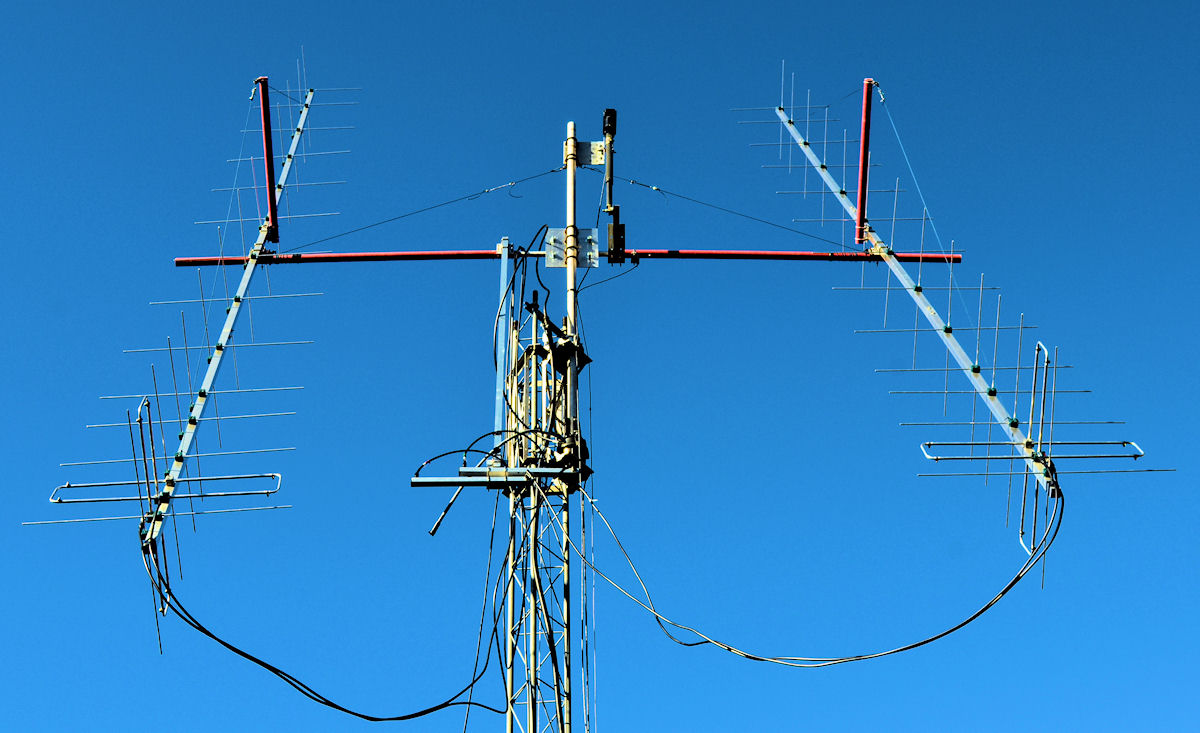
Recently I have been helping Tim, KC8UHE, with his "Big Antenna Project." This project entails removing his current HF Tri-bander and 6-L CushCraft 6-M yagi, removing his Hazer system, adding a 10-foot tower section (tower will now be 57-feet), replacing the 1/4-inch galvanized guy wire with Phillystran, replacing his mast with 21-feet of Schedule 80 and building/installing a Mosley Pro-57B at about 50-feet and a full-size 2-L 30-M beam at about 60-feet. Yes, Tim plans to move up a notch or two in his ability to work the elusive DX!

Below you can see a photo taken the day Dwight, KC8WDT, Tim and I completed the construction on the Mosley Pro-57B (with a timely assist from Rick, W8ZT.) Tim's old antennas are still on the tower in the background. In the center is a photo of Charlie, N8RR, holding the 2-L 30-M beam. Charlie took my old CushCraft 2-L 40-M beam and modified it into a full-size 30-M beam. The boom is 16-feet long and the reflector is just over 50-feet - YIKES!

Since Tim's "Big Antenna Project" adds length to his tower, he needed to replace his coax. He has installed a remote antenna switch just under the eave of his back-porch so only one coax needs to run to the radio. Then, individual runs will be made to each antenna. Also, RF Chokes needed to be made for both the Pro-57B and the 2-L 30-M yagi. That's what this post is about. I began constructing the 30-M choke first and wound 12 turns of Belden 8267 (RG-213) on a 6-inch diameter form. This was held in place with ty-raps and Scotch® 88 electrical tape. You can see the completed 30-M choke below on the right. Click on any photo to enlarge it and use your BACK button to return to this page. The RF Choke for the Pro-57B was only 5 turns on a 6-inch diameter form.


The "Big Enemy" of coax and antennas is WATER! You need to go to great lengths to keep any moisture from reaching the coax as it will corrode the wire and destroy the efficiency of the cable. Toward this end and with a view to the fact that I never want to hear "My RF Choke failed because W8TN did not properly keep out the water," I took great pains to see that no moisture could reach into the cable at the point where the braid and the center conductor are separated for attachment to the beams.

Below you can see the beginnings of the process. First you separate the braid from the center conductor. I chose to slide the braid back about an inch which causes it to bloom out. You can then "make a hole" in the braid by just pulling the fine wires aside and then you can fish the center conductor through the hole by bending it. Then smooth out the braid and slip some heat-shrink over it. Now I crimp a couple of ring terminals on both ends and then solder the lugs onto the center conductor and the braid. When soldering I make sure the solder fills up the center of the crimp connector so no moisture can invade at this point. Next I used some self-fusing water proof tape I purchased at Dayton called Rescue Tape®. You pull this tape to twice it's length as you wrap it and this begins the fusing process. I used this tape to wrap the joint where the braid separated from the center conductor.


Remember, the point of this is to keep ANY moisture from getting to the wire. After the Rescue Tape was applied, I tightly wrapped all the pigtail with Scotch® 88 electrical tape. This wrapping was done with some pressure on the tape so that it's width was reduced to about 3/4 of normal and each successive lap over-lapped the prior lap by 1/2. This stretching of the tape forms a very tight seal and in years past, I've had great success with nothing more than 1 or 2 layers of Scotch® 88 tape wrapped in this manner. Some folks would stop here and call it done. However, I wanted to make absolutely these connections literally last a lifetime so I continued.

On the 30-M RF Choke I then coated the entire pigtail with 3M™ Scotchkote™ Electrical Coating. I've used this many times in the past to make certain that the taped joint is completely water proof. I actually let the first coat dry over-night and applied a second coat the next day. While planning on how to do this water proofing properly I found several references by hams on the Internet to their use of Plasti Dip® or Liquid Electrical Tape. I was not able to find the Plasti Dip at Home Depot so I bought a bottle of Gardner Bender's Liquid Electrical Tape. That is what I used to cover the Pro-57B pigtail (see center photo below.)


Finally, as you can see in the far right photo, I again wrapped the entire pigtail with Scotch® 88 electrical tape. This is necessary as the Scotchkote™ can become brittle and flake off due to Ultra Violet light. The RF Chokes are now ready to be attached to their respective antennas. Using heat shrink, soldered ring lugs, self-fusing Rescue Tape®, liquid electrical tape (or Scotchkote™), and TWO layers of Scotch® 88 electrical tape might be considered a bit over-kill but I'm now willing to bet some serious coin that these pigtails will NEVER see any moisture. But considering that you are now paying more than $1 a foot for good coax, it makes sense to take some time and effort to protect your investment so that it lasts as long as possible.

Thursday, June 24, 2010

Bring Me a Japan on 6-M

OK, everyone else is having all the fun by working Japan on 6-M and I've been left out in the cold. Yesterday Charlie, N8RR, worked his first JA and I'm jealous! So today at about noon I cracked open the box containing a M2 6M7JHV antenna. I had to make a couple of trips over the hill to retrieve the short tower and the coax from my 80-M wire vertical so today has been a "heavy" work day on the leg. By 6 p.m. I had assembled it by myself and, with the help of my wife, Evelyn, I got it installed on a short portable tower in the front yard. She was not too pleased with that but I told her it would be temporary.
The antenna is fixed on Japan so I hope I can snag one of those fellows in the next day or two. If not, I'll move it to the back yard and try to work the C5 (Gambia) which is coming on soon. I have the Commander Amp warmed up and the K-3 is tuned up so now bring me a JA - please?

UPDATE: Well, no Japan was worked during the Short-Path Summer Solstice Propagation (SSSP) period with the new antenna. However, the antenna shown above in the front yard was moved around to the back patio and on July 4th, I managed to get in on some excellent multi-hop Es and worked THREE New Ones - SV1DH (Greece), T77C (San Marino) and EA6SX (Balearic Islands.) That brings me up to 105 Countries Worked on 6-M. WOOF! What a rush! Obviously the fast and temporary installation of the 6M7JHV was a huge success!

But, it seems there is always a high and then a low. On the evening of July 20th we had quite a storm blow through. I felt the antenna on the temporary tower would be safe since it was now located behind the house and as such, out of the wind. NOT! As you can see from the photo at right (click on photo to enlarge) the wind whipped around and toppled the tower and antenna. I'm just lucky that when the 2-inch fiberglass mast smashed into the bedroom door glass, it did not break. Now I need to order some replacement elements from M2 before I can install the antenna on the big tower. One element is completely broken off and two are bent too far to try to straighten. But, it DID get me THREE New Ones, so I'm still a happy camper!

Sunday, May 2, 2010

UPDATE to EME Experiment

Two weeks ago when we listened to EME signals from Arecibo, Puerto Rico, I said I had no photos of Hal, W8HC, because he shot most of the pictures. As it turned out, Rick, W8ZT, sent me a couple of photos he had taken and one clearly shows the Halster sitting at the rig! This was the first time either Hal or Rick had heard signals reflected from the moon!

On the day after Rick and Hal were here, I set the equipment back up by myself and had very good copy on KP4AO for quite some time. They ran CW a lot longer that day and I spent quite a bit of time calling them. Unfortunately, no QSO resulted. But, it certainly was great fun. I'm sure they will do this again and maybe I'll have better luck at that time.

On this second day of listening to KP4AO via EME, I shot a little video so everyone could hear the quality of the EME signals on this day. You can view the 2 minute video by clicking on this link to YouTube. This was not the best I heard them but it is representative of the average quality of the signal.

Friday, April 30, 2010

What a Day of Therapy!

Today has been probably the greatest single day of working out since I began therapy for my broken leg. It started easy enough with a visit to the eye doctor. He dilated my eyes so I when I left his office I was wearing sunglasses and squinting. But, I felt good and the day promised to be a real summer-type day so I started on a project. Last week I had picked up a pallet at Home Depot (for FREE!) that I planned to use as a platform at the base of my tower. I needed something there that would let me sit down and lay out my tools while I installed coax connectors and the like.

The pallet I got was a very heavy duty one that measured 4-ft. by 4-ft. So today I went back to Home Depot and picked up two 2-ft. x 4-ft. pieces of 3/8-inch plywood, some screws, paint, four concrete blocks and other sundries. Back home I screwed the plywood to the top of the pallet then mixed some sand (for traction) into the paint and painted all that I could with up to 3 coats of paint. I used the entire quart of paint.

After the 87° temperature, strong sun and the wind had dried the pallet, I proceeded to carry the concrete blocks over the hill to the tower. Those of you who have made that trip can relate to the difficulty of that operation. It took FOUR trips as I had to BACK down the hill and lift the blocks a couple of feet at a time. I was just not stable enough on my feet on that hill to try carrying them. (Actually, I had two full size and 2 half-size blocks and I did carry the smaller ones for part of the trip.) Then came the fun part. The pallet probably weighs in the neighborhood of 50 pounds and carrying it was possible only for short distances on level ground. I ended up "rolling" it end over end down the hill. Evelyn stood at the top of the hill and watched as I rolled the pallet to make sure I didn't get into any trouble.

At the tower I used a garden trowel and hammer to notch out a place for the blocks with the smaller ones on the uphill side and the larger ones on the downhill because of the slope. I wanted to make the pallet fairly level and, as it turned out, my first attempt had the slope 1.5° downhill and 1.3° away from the tower. That's a done deal! I still need to shim up one of the downhill blocks about 2 inches to make the pallet stable but it's in place and ready to use now. The sand in the paint (an idea from Rick, W8ZT) gives very good traction.

Bottom line - I now have a very nice, stable, and level place to work on everything at the base of the tower. And, I made a total of SIX trips down and up the hill (in addition to all the stuff at Home Depot, in the garage, painting the pallet, etc.) So, I truly gave the leg a workout today. I may not be able to roll out of bed in the morning, but right now I feel really good about what I got done. You can click on either photo to see a larger image then use your BACK button to return to this page.

Saturday, April 17, 2010

EME Experiment to Hear KP4AO from Arecibo

This weekend a group of hams were operating EME (Moonbounce) using the 1,000 foot diameter radio telescope at Arecibo, Puerto Rico. They used the call KP4AO. I decided to try and see if we could hear and maybe work them using a single yagi. So, we set up the antenna in a make-shift manner on the patio and proceeded to point it at the moon and listen during the time KP4AO was on the air. We were able to monitor a real-time computer link of the operation and compare it with what we heard. KP4AO made 103 QSO's in about 2-1/2 hours of operation. We copied their SSB signal quite well at times but usually it was pretty much in the noise. When they finally shifted to CW, we were able to hear them very well. We were not able to make a QSO with our kludged together station but we gave it a good try.

Below you can see the K1FO 25-element yagi we used for the Arecibo, Puerto Rico, EME experiment today. The yagi is supported by a mostly fiberglass stepladder and secured to it by a rubber strap and dacron line at the base. The rear of the antenna is supported and raised above the concrete patio by a cardboard box. In the second photo you can see the "manual" method of antenna positioning. As long as we could see the moon, it worked well. But, with the moon so close to the sun today, only a very tiny sliver of a crescent was visible and that could not always be seen. In the photo on the right, you can see our "Target" in the upper right-hand portion of the image. You need to look really close to see it. In this photo the moon had moved away from where we were pointed and a re-positioning needed to be done. (You can click on any photo for a larger image then use your browser's BACK button to return to this page.)


Below are a couple of photos of myself, W8TN, and Rick, W8ZT, operating the station. Rick brought an Icom IC-706 and a 150-watt amplifier. You can see the Bird wattmeter on the chair between us in the first photo. Feedlines were REALLY short so we had essentially no loss to consider.


Hal, W8HC, was the photographer so we have no shots of him but he also spent a good deal of time on the mike and on the key trying for a contact. What a hoot it would have been to hear his call come back from the moon! Maybe next time.

Tuesday, March 9, 2010

A NEW 160-M Antenna for W8TN

After I discovered last Friday that the vertical portion of the 160-M Inverted-L was broken off at the feed point, The Archer, Charlie, N8RR, volunteered to bring his trusty bow and weighted arrow to my QTH and fire a line over one of my trees to erect a NEW Top Band antenna. I then gathered up all the materials last night and this morning Charlie showed up followed by the DX Hunter, Tim, KC8UHE. The three of us managed to make it down the hill without incident and in less than 80 minutes, we were done! Charlie fired his arrow perfectly over the nearest tall tree at such an angle that it not only cleared that tree but one further along and the arrow then fell all the way to the ground. That meant the vertical portion of the Inverted-L would rise almost straight up and then be horizontal at the top - a near textbook installation.

Charlie had fishing line attached to the arrow which he removed and attached to some light line. The fishing line was reeled in and the end of the light line was attached to a piece of Dacron antenna support rope. That was pulled up and over the trees and then it was used to pull up the end of the Inverted-L. Tim and I had cut a 135-foot length of No. 14 stranded copper cable for the antenna. I decided to cut it for 135-feet even though I thought it would end up at 130-feet after trimming the antenna to resonance. I just wanted to make sure I had enough wire in the air before tuning it. Charlie said he thought the antenna should be 130-feet (just what I thought!) and he suggested we go ahead and shorten it by wrapping the last 5-feet back on the end of the antenna. We did that.

I then attached the MFJ-259 antenna analyzer to the feed point and WOOF! - it was resonant at 1.809 MHz. Good enough for government work. Tim then used my chain saw to remove a couple of trees, one of which had fallen on the North set of guy wires. We then gathered up our tools and came topside to check out the antenna with the N8LP Digital Vector RF Wattmeter. You can see the result of that sweep on the Left (click on the photo for a larger image.) The antenna (as measured in the shack) is 1.34:1 at 1.800 MHz, 1.28:1 at 1.820 MHz, 1.57:1 at 1.840 MHz. and 2.0:1 at 1.862 MHz. If I recall correctly, this is even better than the previous Inverted-L.

As we were pulling up the wire, when the insulator on the end of the wire transitioned from vertical to horizontal at the top of the first tree, Tim and I estimated that we only had about 30-feet of wire left. That should mean that close to 100-feet of the antenna is vertical. Boy, oh boy! I can hardly wait for SV5 to show up tonight! He's MINE!

Thanks again to The Archer and the DX Hunter for their fabulous help. I'm really excited about being back on Top Band, if only for the very end of the season.

Friday, March 5, 2010

My First Trip "Over the Hill"

With the weather finally beginning to look like something less than you would find in the Arctic, I felt it was time to give the old broken leg a test and see how it could deal with the "Hill" behind my house. I have not been down to the tower since sometime in June of 2009 (maybe 9 months!) With the 160-M Inverted-L being out of commission, I felt I needed to go and check things out to see what I could do to fix that. And I wanted to see if I could find out what is wrong with the SteppIR. I had noticed a couple of weeks ago that the SteppIR was not functioning properly. Testing from the shack showed that there was no continuity to one of the motors that drives the Reflector. I had thought it might be a broken wire in the control cable and surmised that a deer might have stepped on that cable or a tree fallen on it.

Unfortunately, in checking the exposed cable all the way from the underground PVC pipe at the top of the hill to where it goes up the tower, nothing was found that could cause that problem. Rats! This will not be an easy fix.

But, I did find several other things that were not right. There were 7 or 8 trees or large limbs that have fallen either due to wind or snow this winter. One tree is across the NE guy wires so it needs to be removed SOON! I also found that the 2 elevated radials for the 80-M Vertical that Charlie, N8RR, and Tim, KC8UHE, installed had fallen down. I managed to force my way through the briers and brambles to find a place to tie off those radials. When I got back top-side, I ran a check on the SWR for the 80-M Vertical and it looks very good. See the graph at Right - click on the image for a larger view. The SWR is under 1.5:1 from 3.500 MHz to 3.600 MHz with the best SWR being 1.13:1 at 3.550 MHz. Nice!

I then noticed that one leg of the 80-M Inverted-V was hanging straight down the side of the tower. It seems the tree that fell on the NE guy wires may have pulled the wire for the 80-M Inverted-V out of the end insulator. Thank goodness I had not soldered or otherwise strongly secured that wire or it would have pulled down the entire antenna. I found the rope and end insulator, retrieved them from the fallen tree, re-connected the insulator to the end of the Inverted-V and pulled it up and attached the rope to another tree. Back in the shack I ran a test on the 80-M Inverted-V. See the graph at the Left - click on the image for a larger view. This antenna is under 2.0:1 from 3.765 MHz to 3.950 MHz. Also fine!

One of my main reasons for going over the hill today (in addition to checking the SteppIR control cable, was to see if I could get the 160-M Inverted-L back in operation. That did not happen. What I found was that the vertical portion of that antenna had broken off right at the feed-point. The wire was still secured at the top of the tower but the horizontal top-hat had obviously either come loose at the far end or broken because it was draped in the tree-tops. So, in order to repair that antenna, I need to somehow get another wire either up the tower and out to a tree or just up and over a tree. Maybe Tim or Charlie can bring their bow and arrow and shoot a line over a tree enough to let me at least get back on Top Band before the season is completely over.

All-in-all it was a very good trip. I found that my re-hab of the broken leg has improved to the point where I can get down over the hill and back up. I even climbed up the tower about 3 rungs just to see how that went and it was fine. But, the bad news is that the SteppIR fix is going to be a little more involved. After a long conversation with Tech Support at SteppIR the consensus is that either the control cable has "rubbed" against something on the tower and broken one wire OR a wire has broken at the connection point where the cable attaches to the barrier strip on the boom of the antenna. In any event, it can't be fixed from the ground.

Saturday, February 6, 2010

Mr. Snow Plow

This has been an especially snowy winter for us. In December I think I spent about 4 HOURS shoveling snow or blowing the powdery snow off the driveway (and doing that with my broken leg and cane was a challenge to say the least!) The leaf blower worked rather well up to about a 3-inch snow fall as long as it was very cold and the snow was dry. However, we did get one snow of a little over 12-inches and that was just too much to shovel. Thankfully my neighbor (the contractor who built our house) came over and plowed the driveway with his 4-wheeler.

Right after that, Tim, KC8UHE, was by the house and mentioned that he had a 4-wheeler that he only used for hunting and now that hunting season was over, I was welcome to borrow it. Tim made that offer on a Wednesday afternoon and we were aware that another big storm was due the next day. So, on Thursday morning I drove to Charleston and bought a snow blade to fit Tim's 4-wheeler. I then picked up our utility trailer and went to Tim's and loaded the 4-wheeler. Back at our house, our son, Darren, KC8QGV, came and installed the blade. It began snowing while he was doing that and by the time the blade was installed we had over an inch and Darren gave it a test drive.

At this point I've used the snow blade 4 times including the 2+ inches of heavy wet snow we had today (see photo - click on photo for larger image.) Twice I've also plowed the driveway for the neighbor on the other side of our house. This tool is totally the "berries." I'm going to have to buy one before Tim needs his back for hunting!


Friday, December 11, 2009

Twisted SteppIR

On Wednesday we had some high winds. Various places close to me measured 62 MPH and as much as a 74 MPH gust. I was gone all day and when I got home, it was too dark to tell any more than the tower was still standing. In the light of day I was able to see that the SteppIR got twisted a bit by the wind. Below you can see two views of the antenna that is canted at about a 30-degree angle from horizontal.


Using the telephoto lens of my camera I was able to see that the truss wire on the driven element side of the antenna has come loose. It can be seen hanging down below the antenna. (Click on any photo to enlarge it and use your Back button to return to this page.) Below you can see the reason the truss wire is no longer connected. The turnbuckle came unscrewed. Apparently there was no safety wire put through it during installation. In the first two photos below you can see the turnbuckle body hanging from the boom and it is missing the end that attaches to the mast. On the second photo you can see the missing "eye" that is still attached to the mast.


On the third photo I have put an arrow that shows the EZeye eyebolt. This is used during installation to quickly and easily secure the SteppIR to the mounting plate before attaching the U-bolts. I can't tell for certain but it looks like the SteppIR boom has rotated in the U-bolts and has been stopped from further rotation by the bolt hitting the mounting plate.

Repair should be simple. just loosen the U-bolts and return the antenna to horizontal, then reach out and retrieve the truss cable and re-connect it to the mast. This time, a safety wire WILL be put through both turnbuckles so this does not happen again.

This minor damage to the SteppIR installation is not the extent of the wind damage here. The 160-M Monster-L was working great on Thursday morning when I checked out the antennas. However, this morning the SWR was nearly 7:1. Possibly something failed last night as we continued to have high wind on Thursday. Also, the 80-M Inverted-V is no longer functional. I suspect either one leg has come loose or broken on it. So, some of the wire antennas need a little work in addition to repairing the truss wire on the SteppIR. Then, we will again be back in business.

Saturday, November 21, 2009

W8TN is BACK on Top Band!

Today, Mike Null, NU8LL, and Eric Mynes, K8OHZ, came to the Hill and pulled up the 160-M Inverted-L. That antenna had not been replaced on the tower when we did the antenna installation of the SteppIR. But today, Mike climbed the tower with Eric as Ground Crew and re-installed the Inverted-L. Mike also removed the gin pole and rope and brought them back up the hill with the roll of Phillystran.

As you can see by the SWR plot of the 160-M Inverted-L on the right, I'm now "back in business" for Top Band. The SWR ranges from 1.45:1 at 1.800 MHz to 2.0:1 at 1.869 MHz. At 1.850 MHz it is 1.72:1 and the lowest SWR is at 1.819 MHz where it is 1.19:1. I would say that is just darn near perfect since I have no series capacitor or other tuning network to do any matching at the base of the antenna.

I guess tomorrow I'll have an early wake-up to try for TX3A on Top Band. I was up at 3:00 a.m. this morning for 2-1/2 hours trying to work them on 30-M when they were S-9 here but nothing! So, hopefully tomorrow morning will bring good luck for me. But, just to see if the antenna was functioning, I took a look at the band and found OE3I operating in the Austrian 160-M Contest. I do NOT have Austria confirmed after sending a Direct QSL 2 years ago. So, I called and worked OE3I with very little trouble. And here's the good news, HE's ON LoTW! YIPPEE! I'm BACK!

Thursday, November 5, 2009

W8TN is WALKING Again!

Today I visited the Orthopedic Surgeon who had repaired my broken leg. He took another X-Ray (see the photo at right - click on it for a larger image), looked over the leg, felt it, moved it, and said I was now cleared to do whatever I want! YIPPEE! It's been 4 months and 2 days since I broke the leg.

Actually he did schedule me for 6 more weeks of Physical Therapy (3 times a week) which will be pretty intensive. Strength Training, Gait Training, more Flexing, etc. I'm sure the people in P.T. will turn the screws tightly now as before I was limited to NO weight bearing on the broken leg.

WOW, I can't tell you how good it feels to not be just marking time (or so I thought) waiting for everything to heal. The surgeon was very pleased with how the incisions had healed and he liked the look of the X-Ray. He said he had been pretty worried about an infection and with my diabetes how well the healing would go. However, Evelyn has kept me on the straight and narrow with my diet and for the month of October my fasting blood sugar readings averaged 116 with a high of 139 and a low of 92. This is great as I'm still healing somewhat so the readings may even go lower once I'm past that stage and start getting more exercise.

Actually, as soon as we got home I put on my shoes and have been walking all over the house using the walker but now I'm not "hopping." I'm bearing weight on the broken leg and actually WALKING! WOW! (It didn't take too many walks to get tired though - I really need to build up my strength!)

You never really appreciate the simple things in life until they are taken away. I have so much empathy for those people who are stuck in a wheelchair without the possibility of ever getting out of it. It's definitely a hard road.

Looks like if I ever fly somewhere, I'll set off the metal detectors for miles around!

Monday, November 2, 2009

W8TN's Antenna Project - Phase IV

The last work on the W8TN antenna project was just over 3 weeks ago. A HUGE amount of work was done but we came up a bit short on time to finish the project. Since then the coax feedlines and the control cables have been entering the ham shack through the window. See the photo below for how it looked (click on any photo to view it larger.) This worked OK for awhile but with the nights getting colder, it was starting to become a problem. Also, the need to lift up the coax to allow the wheelchair to roll underneath it led to me not keeping the antenna connected all the time.

So today, Tim, KC8UHE, Mike, KE8V, and Apollo (the Archer), N8RR, came to remedy that problem. In addition to running the cables underneath the house, they were kind enough to erect a KILLER 80-M Vertical down over the hill. The "Archer" brought his trusty bow and amazed Tim with his ability to loft an arrow with great finesse over the exact limb of the tree which was chosen to support the vertical wire. Below (L-R) you see KE8V, The "Archer", and KC8UHE.


I look at these "projects" as my way of helping the hams become "Heart Healthy." The climb up the hill is a great workout!

I cut the vertical portion of the wire for the vertical as well as the two radials to Apollo's specifications of 66-feet. I then crimped and soldered ring lugs onto the wire to make connection to the center insulator easy. Apollo shot his arrow over the chosen branch and pulled up the wire. He says about 5 inches of the vertical and radial wires were used to attach to the insulators. The MFJ-259B meter was put on the antenna and it was deemed DONE. To the right you see the SWR plot of the finished antenna done from the shack with my N8LP LP-100 Digital Vector Wattmeter. The best SWR is 1.03:1 at 3.535 MHz. It is 1.35:1 at 3.500 MHz. and doesn't pass 2.0:1 until you reach 3.656 MHz. I'd say that's going to be one heck of an antenna.

Again I want to express my sincere appreciation to the members of the WVDXA who have taken so much of their time to help get my station operational again. Once the 160-M antenna is pulled back up the tower, I'll be SET. Look out DX, here I come!

Saturday, October 17, 2009

SteppIR Tuning Relay

Since my 4-element SteppIR antenna was graciously erected by the WVDXA members last weekend, it was now time to build up the SteppIR Tuning Relay I had purchased long ago. The SteppIR Tuning Relay is a device that connects between the PTT line of the transceiver and the PTT input of the amplifier. SteppIR specifies no more than 200 watts be applied to the antenna while it is being tuned from one frequency to another. Doing so could damage the antenna and result in an expensive and time-consuming repair.

So, Larry Phipps, N8LP, has designed a device to detect when the SteppIR is moving and break the PTT line to the amplifier during that time. You can see all of Larry's fine products on his WEB SITE. In addition to this SteppIR Tuning Relay I also own his LP-100 Digital Vector Wattmeter which I dearly love!

After unpacking and checking all the parts I began placing them on the circuit board. This consisted of sticking the leads through the plated holes, soldering them in place and cutting off the leads. I took my time attempting to do a fine job. You can see both the underside and top side of the completed board below (click on any photo to see it larger):


The assembly went easily and took about 2 hours. Once I had all the parts mounted I double checked the placement of the diodes, relay, transistor, and I.C.'s to make sure I had made no mistake. I cleaned the excess rosin off the bottom of the board and then made the simple resistance and voltage checks. Everything checked out OK. At that point I placed the circuit board in the case and buttoned it up.

During normal operation of the SteppIR antenna, an "asterisk" blinks on and off on the SteppIR control box indicating that the antenna is tuning. That is just not enough of a warning to keep you from engaging the PTT and calling the DX especially after you have clicked on a spot which caused your rig to change bands and the SteppIR is moving to the new frequency. With the SteppIR Tuning Relay in place, I now do not worry about accidentally engaging the Alpha while the antenna is moving!

Below you can see a photo of the Tuning Relay to the right of the SteppIR control box. Note that the Asterisk is blinking on the SteppIR control box and the Red LED is lit on the Tuning Relay indicating that it has interrupted the PTT line to the linear.


In tests with the amplifier all works perfectly. Now I can comfortably interface the SteppIR controller to the computer so that the antenna will automatically change to the appropriate band when I click on a spot. That is one more step to both automating the station and assuring that the operator does not forget to change the antenna when he changes bands (like I did when I was chasing K4M!)

Wednesday, October 14, 2009

W8TN's Antenna Project - SteppIR Installation

OK, we set the official date for the installation of the SteppIR 4-L yagi with the 30/40-M option for Sunday, 11 October 2009. I put out the call on the WVDXA Reflector for persons who would be willing to come and help with the operation. Several people responded that they would be there. However, I was more than a little surprised to see that TWELVE hams showed up to help. What a fantastic turnout! I did not get any photos of all 12 at the same time but here is a single shot with 9 of the guys (click on any photo to view it larger.) All photos except this first one were taken by Hal, W8HC.


There was a lot of discussion about what had to be done and then folks just started DOING stuff. I am still stuck in this wheelchair so all I could do was supervise from my hamshack door. I had stayed up until 2:30 a.m. the night before getting all the "parts" ready. Tim, KC8UHE, had taken me "shopping" on two days in the prior week to acquire all the bits and pieces we would need. We had communication over 2-M H.T.'s between those outside and myself in the shack so everyone knew what was happening.

Mike, NU8LL, aka the "Tower Man", arrived and hit the ground running. He began instructing the ground crew in how he wanted them to do everything while he was up on the tower. Safety was stressed all around and I'm proud to say no one received any sort of injury during this operation. Here some of the Ground Crew are shown pulling on the rope (well away from the base of the tower) to raise the antenna (L-R, KC8UHE, KE8V, WA8VPN, & N8RR):


In the following photos you can see the antenna as it reached the top of the tower and then after Mike, NU8LL, flipped it over and attached it to the mounting plate. The antenna is now UP. It sits atop a Rohn 45 tower at about 86-feet above ground. The hillside behind the house slops very steeply so that the base of the tower is 30-feet below the top of the hill.


The group was here for as long as TEN hours but when they left, the antenna was atop the tower and fully functional. All the fine details were attended to and the only job left is to run the coax through the PVC tubes up to the top of the hill and then through more PVC underneath the back yard and up into the shack. In the interim they thoughtfully brought the cables up to the hamshack window so that I could go ahead and put the station on the air (and I have!) Come Spring a 6-M beam will be installed above the SteppIR but in the meantime, I'm back on the air!

I should also mention that my wife, Evelyn, cooked up a large pot of homemade chili, and made a couple of pans of Brownies! That made for a wonderful meal break before the guys began pulling up the antenna.

Here is an 8-minute video that shows several scenes of the operation. The video was shot by Garry, W8OI. On the bottom row of the YouTube video below, you can click on the next to the last icon (a small rectangle inside a larger one) and it will switch to Full Screen mode. Press your ESC key to return to normal mode.


As an extra added benefit to the day, the DX'er Emeritus of the WVDXA, Bob Hall, W8QHG, was celebrating his 93rd birthday the very next day. So, unknown to Bob, the WVDXA surprised him with a Birthday Cake and a Card signed by all the club members present. He was truly surprised and I was amazed that he stayed here for 6 hours watching the installation. Here is a short video of the presentation of Bob's Card and Birthday Cake:


Below you see the beneficiary of all this work, W8TN, peering longingly out of the hamshack door. I so wished I could have been out there in the middle of all this activity.


I want to especially thank all those who were here that day:
Bob, W8QHG - Charlie, N8RR - Pete, K4OM - David, W8IW - Lonny, WA8ZDL - Dwight, KC8WDT - Garry, W8OI - Mike, KE8V - Hal, W8HC - Bob, WA8VPN - Tim, KC8UHE - And, our Tower Man, Mike, NU8LL.
I also want to thank those other members of the WVDXA who helped previously both in person and on the email reflector. It is my privilege and honor to belong to such a wonderful group of hams. It just doesn't get any better than this!

Now, Bring On the DX - I'm READY!

Friday, October 2, 2009

W8TN's Antenna Project - Phase III

A funny thing happened today. I had a mis-communication this week with Mike Null, NU8LL, about when he was going to come and do some work on the tower project. So, about 1:30 p.m. Mike called to say he was on his way to the house and was apologizing for taking so long to find all his equipment. WOAH! The last communication I had with him was me asking him how many folks he needed to help him. Somehow, I never received the email he sent me on Thursday night so I thought the work was called off due to the chance of rain today. Mike thinks he was in a bad coverage area all day yesterday and his iPhone failed to properly send the email to me due to lack of network coverage.

THANK GOODNESS Tim, KC8UHE, was off work and agreed to drop everything and come up here to help. I sure hope Tim did not miss a chance to work FT5GA because of his unselfishness!


Above you see the entire crew for today's work. Mike on the left and Tim on the right. That meant Mike was the "tower guy" and Tim was "ground crew." It also meant that Mike stood on the tower for a few hours while Tim ran up and down the hill - again, and again and again! Poor Tim, his legs must be killing him tonight.

Below you can see a close up shot of Mike in his climbing gear. Also, another shot of him on the top of the tower. I had one little "clearing" in the trees where I could see him from the hamshack. So, I shot this photo through the window in the shack. He is right at the top of the tower.


You can click on any photo to see a larger image.

Anyway, in about four hours this two-man crew accomplished the following: removed the TailTwister rotor from the tower, removed the current rotor cable, installed a new thrust bearing on the top accessory shelf, installed the M2 Orion 2800AC rotor (that puppy weighs 45 pounds!) - the installation of the bigger rotor meant the mounting holes had to be slightly enlarged so Mike had to mount and remove the rotor in order to get the holes right. They then pulled up and connected the new rotor cable, dropped the mast onto the new rotor, secured the thrust bearing and did several other small jobs associated with this rotor installation.

In addition, Tim sprayed more Roundup and cleared the brush from the guy anchor positions. I think there is one small tree that still needs to be removed and that may require Papa November's brush cutter.

On Thursday I had prepared the pigtail on the rotor with a quick disconnect connector and ran the rotor through its check out and calibration routine. While the first part of the work was being done today, I installed the mating connector on the rotor cable which was just delivered by UPS yesterday.

The good news now is once we acquire a couple of missing flat washers and some stainless steel spacers, 200-feet of PVC and a "pull box" to connect the PVC together, and some other miscellaneous items - we are READY to pull up the SteppIR! Tom, AB8RL, came by on Tuesday and went over the hill with the SteppIR controller and an MFJ-259B and confirmed that the antenna functions properly after its two-year hibernation standing beside the tower.

Pizza Hut kindly delivered a pizza for the crew at the end of their work so everyone got some calories to make up for all that were expended today. The completion of this project is getting so close that I can almost smell the finish line!